I discovered Ali Abdaal just a month and a half ago, and he’s already one of my favorite YouTubers. This is what I like about him.
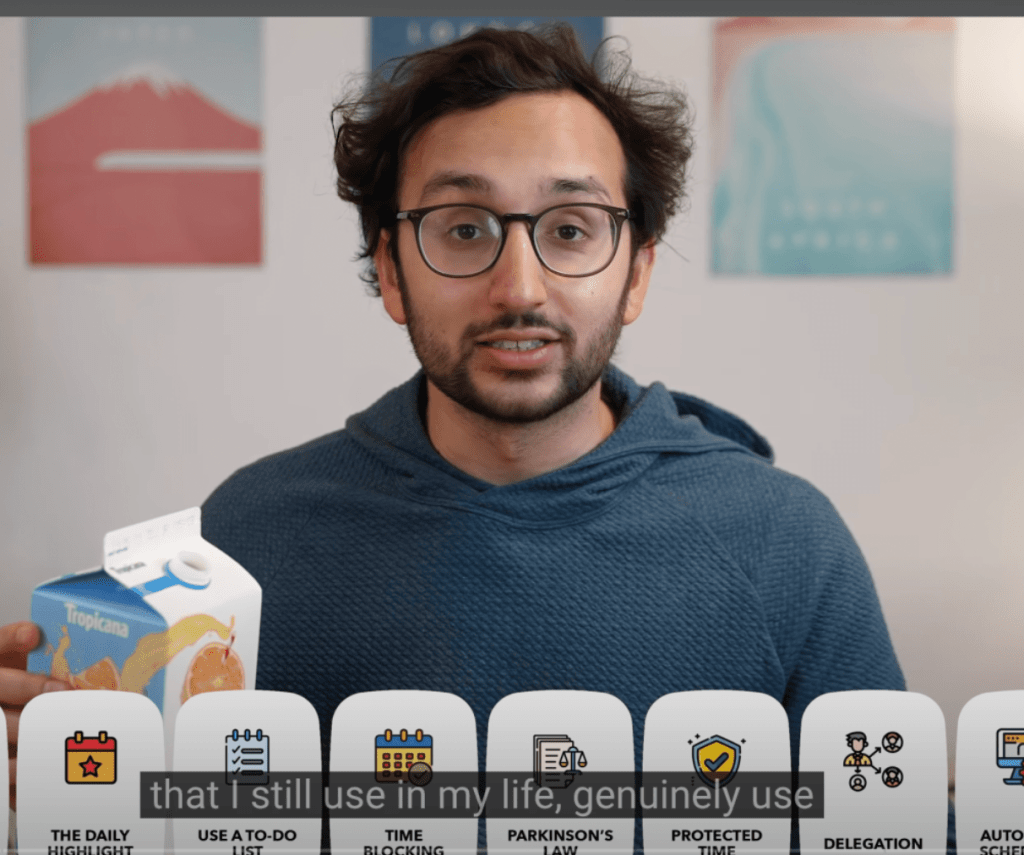
A few reasons I like him
- Personality. He has a likable demeanor – smart, direct, and matter-of-fact, but also humble, unassuming, and sometimes endearingly self-deprecating.
- Channel Variety. He is not too niched down; he covers a variety of topics. His principal focus has been productivity, but he’s regularly veered from that, even more so in recent years, to other topics like book reviews and summaries, dating, romantic relationships, life happiness, advice for teenagers, recommended tech tools, and interviewing others.
- Production Value. He talks fast, which is good for content delivery because it keeps viewers’ attention. He uses cute icons and graphics in his videos (like Facebook reacts) and features a writing pad on screen to convey concepts as bullet points. He #s his points or recommendations and speaks directly to the camera.
I don’t need him that badly but he’s helpful
Perhaps because of life experience, much of what he advises others isn’t new to me. I’m not in school now, but I spent so many years in college and multiple graduate programs that I naturally developed good executive function and created productivity and time management systems that continue to serve me in my personal and professional life. I was this way as a kid, teen, and young adult, too, rarely needing anyone to motivate me to apply for education programs, seek part-time or full-time work, or start new projects and skill build. I’ve generally approached big tasks by just taking the first step, then the step after that, then the step after that, etc. It’s as simple as that to see things through to completion.
I still like watching Abdaal for continued motivation and assuring myself that I’m on the right track! Sometimes well-motivated people with good productivity practices have not thought about why or how their routines and behaviors have served them; getting clarity from his explanations and rationales can be affirming.
Abdaal’s counsel is probably even more helpful to people who haven’t been natural self-starters or meaningfully reflective.
Though he has lots of sage advice, these are three recurring points I always agree with and feel have helped me in life.
Ali Abdaal advice I agree with
Don’t overanalyze or lollygag. Just start.
Many of his videos talk about the importance of taking action. The way I’ve heard another YouTuber put it is “create a bias toward action.” People too often deliberate forever, think and re-think, tell themselves they’ll do it after eight or ten other things are in place, or decide they must fully master specific skills before taking first steps, etc.
All that thinking and they never actually start anything. This is a mistake because only by starting can you get anywhere. This is not to say you can’t get some things in order first, or learn some skills toward mastery, or do some pre-thinking and pre-planning. Too often, though, people get caught up in preliminary non-action and never actually take a first step; the project never gets off the ground, and the goal is never met.
Pick jobs and careers based on tasks you like to do.
He says that a big reason people end up unhappy in their line of work is that they don’t consider what they actually like to do at the individual daily tasks level. Instead, they choose their path based on a general job title, pressure from family to hold a certain role, the income potential of a particular profession, societal perception of status and prestige, etc. Sometimes when you choose this way, you do luck out and like the tasks and overall context of work you end up doing. More often, you don’t; all you get from the whole thing is the job title you wanted or the income you wanted. But you’re miserable, to varying degrees, because you’re not fulfilled or you think what you do each day is a drag.
It’s especially pertinent coming from Abdaal because he went to medical school at Cambridge to be a doctor, which I believe was a route he took because of family pressure (perhaps some interest on his part, too), but what really drives him is being a YouTuber, podcaster, writer, speaker, etc., and helping people live fulfilling and productive lives. He seems to thrive on that much more than on being a doctor, though he does (did?) practice medicine part-time.
Also, it’s not enough to pick the right field; you have to pick the proper role within that field. For example, I’m in the right field for who I am and my interests, strengths, and values: education. For a long time, though, I was not in the role that most suited my personality and preferences for daily tasks. Though I liked classroom teaching and was solid at it, I don’t like it as much as I like instructional design. Classroom teaching requires enjoying performing, being “on” a lot, a degree of extroversion, and a lot of public facing (with students, administrators, and parents if you teach K to 12). Since I prefer behind-the-scenes ‘head down’ work and am more introverted but still like creating learning and the field of education, instructional design makes more sense for me.
The point is…you have to know yourself, what you like, the tasks you like to do, and how you like to do them, and be true to that.
Build community and put yourself out there.
In recent years, I’ve gotten increasingly on board with the notion of building community. Previously, I was more of an island of myself. In the spring of 2020, when we first went into lockdown because of the pandemic, I said to people that I was better able to handle social isolation than others. (I wasn’t truly isolated; I had a lot of contact with friends, family, and acquaintances on social media and some socially-distanced visits.) But I insisted I didn’t crave in-person socializing that much, and perhaps I didn’t, compared to others.)
In the past three years, however, I’ve been more attentive to small elements of mental health. I recognize how much better I feel when I socialize in person at least once a week and, more ideally, 2 or 3 times a week. Community and human connection are important.
Abdaal’s whole thing is…plant seeds of connections. In one of his videos, he tells new YouTubers that if they want to grow, it’s essential that they increase their “area.” This holds true for many aspects of life, not just growing a YouTube channel or getting job opportunities, but also for dating, family life, etc. The idea is that everything is some form of a numbers game; thus, increasing your contacts is helpful. Don’t worry about whether you’re gaining from any particular contact. Even if there’s no direct benefit or gain – small or ‘big break’ in nature – you’re making a human connection, which is good for you and the other person.
Expanding your area
Expanding your area gives you a greater chance of having luck being invited into an opportunity or being encouraged to level up in a way you wouldn’t have without the connection(s).
Despite having a degree of distaste for professional networking and being overly ambitious, I can see the merit in all this. That said, my desire to increase my area is more social. I never think anyone will connect me to work or money. I do, however, like the idea of more community for personal reasons, for good experiences, and for feeling like part of the world with other people.
Building community goes with Ali’s related encouragement to “put yourself out there.” It’s so easy not to do – I’m guilty, too – because we’re tired, unmotivated, and gunshy from previous attempts to put ourselves out there (in whatever way). I honestly love not putting myself out there. But I must admit, on the occasions I’ve “put myself out there” (while building community or not), I’ve thought…yes, this was a good move.
So, he’s on to something. Build community and put yourself out there.
I encourage you to subscribe to Ali Abdaal’s channel. He’s a fantastic life coach and productivity guru. His insights and helpful advice go far beyond the three wisdom nuggets I’ve covered here.
 Jane Nguyen
Leave a comment