Understanding and Applying Emotional Intelligence

This self-paced WBT course was developed for the University of Maryland Global Campus Emerging Leaders program to help staff aspiring to leadership roles strengthen their understanding and application of emotional intelligence. Working primarily from SME-provided source content, I conducted additional research to fill content gaps, aligned material with the learning outcomes, and refined and reorganized an initial course structure inherited from another instructional designer.
The course explores key elements of emotional intelligence and emphasizes their practical application in workplace situations. It also incorporates an emotional intelligence assessment that learners can complete before or during the course, providing an opportunity to connect course concepts with their own strengths and areas for development.
OpMed Care Delivery Platform (CDP)
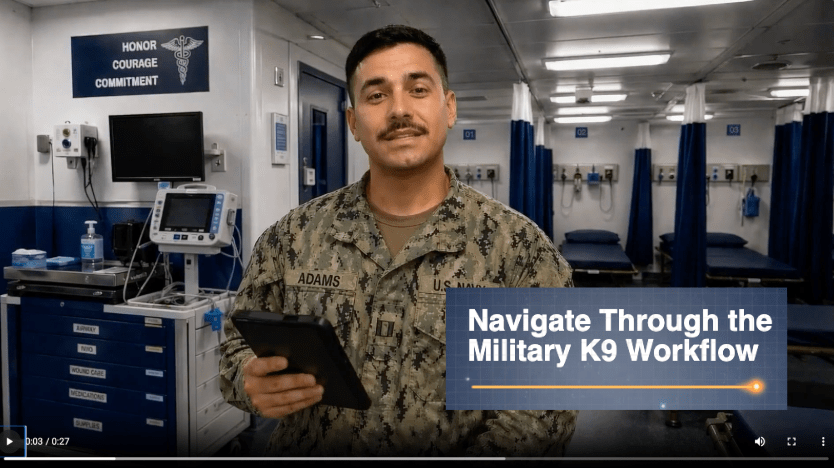
Navigate Through the Military K9 Workflow is a computer-based software training module developed as part of the larger OpMed Care Delivery Platform (CDP) training program. CDP is used by military healthcare practitioners to document patient care in operational environments. The broader training covers platform functions and workflows ranging from basic navigation to mass casualty events, inpatient workflows, and surgical procedures. I contributed to multiple modules within the program; featured here is my K9 Workflow module, which teaches users how to document injuries, medications, and treatments for military working dogs.
Performance and Conduct Management for Laboratory Supervisors

This self-paced, scenario-driven WBT was designed for CDC laboratory supervisors to help them distinguish between employee performance and conduct issues and determine appropriate ways to address them. While performance issues may stem from gaps in an employee’s knowledge, skills, or training, conduct issues involve employees who are capable of meeting expectations but do not follow established policies or requirements. Through realistic workplace situations, supervisors explore the gray areas between performance and conduct and practice identifying and responding appropriately to each.
 Jane Nguyen